
Television Advertising: Benefits, Strategies, and Effectiveness

Television Advertising Benefits, Strategies, and Effectiveness
In an era dominated by digital noise, screens continue to command the living room with unrivaled emotional power. Television Advertising remains a cornerstone of enterprise marketing, blending sights, sounds, and storytelling to capture consumer attention like no other media channel. This comprehensive guide explores the evolution, core benefits, strategic planning, and modern measurement frameworks of Television Advertising. Readers will discover actionable blueprints for linear and connected TV campaigns, optimizing budget allocation, avoiding costly pitfalls, and maximizing campaign effectiveness through data-driven insights.

The Evolution of Television Advertising in the Digital Age

Television Advertising has undergone a profound transformation over the past decade. Traditional broadcast models relied entirely on broad demographic assumptions and household ratings. Today, technological advancements empower modern marketers to combine the immersive storytelling of the big screen with precise digital data targeting. Brands no longer broadcast blindly to entire regions; instead, they reach specific audience segments based on precise behavioral patterns, viewing habits, and purchasing intent. This evolution bridges the gap between traditional brand building and performance-driven marketing.

From Linear Broadcast to Connected TV (CTV)

Linear Television Advertising remains a powerful vehicle for mass-market awareness, delivering simultaneous reach to millions of households during major live events, sports broadcasts, and prime-time programming. Simultaneously, Connected TV (CTV) has revolutionized the media landscape by streaming content via internet-connected devices, smart TVs, and streaming sticks. Connected Television Advertising introduces granular addressability, interactive ad formats, and real-time optimization, allowing enterprise brands to tailor messages to specific household clusters while maintaining the cinematic quality of traditional viewing experiences.

Programmatic Buying and Advanced Audience Segmentation

Programmatic technology automates the buying and selling of Television Advertising inventory. Marketers utilize demand-side platforms (DSPs) to bid on ad impressions in real-time, leveraging first-party and third-party data sets. Advanced audience segmentation shifts the focus from network programs to specific viewer profiles. Whether targeting auto-intenders, luxury shoppers, or fitness enthusiasts, programmatic workflows maximize media efficiency and minimize wasted impressions across both linear and streaming environments.

Core Benefits of Television Advertising for Modern Brands
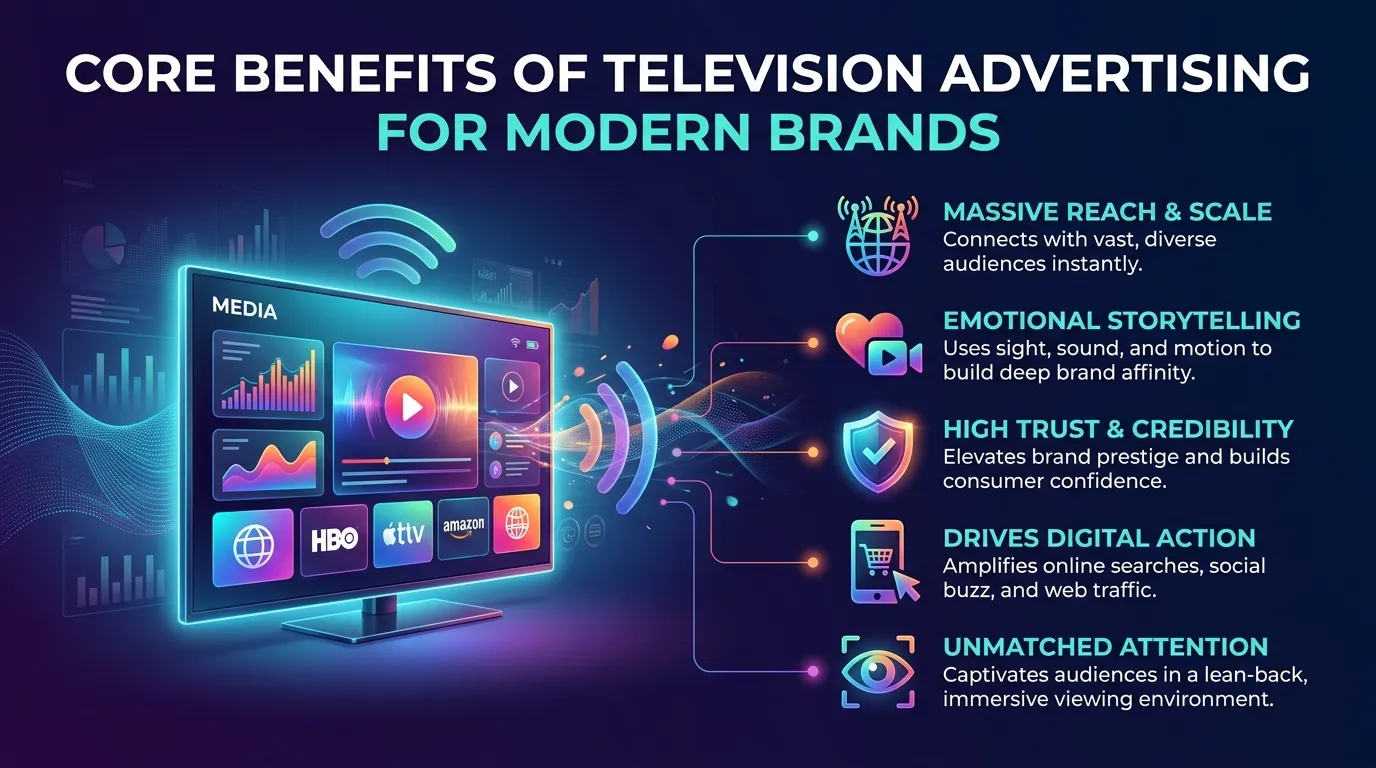
Core Benefits of Television Advertising for Modern BrandsInvesting in Television Advertising yields distinctive advantages that digital-only channels often struggle to replicate. The medium commands undivided attention in a comfortable household setting, where viewers consume content on large screens with high-fidelity sound. This environment fosters deep emotional connections, elevates brand prestige, and accelerates consumer trust. Furthermore, effective Television Advertising drives powerful halo effects, boosting search engine queries, social media engagement, and direct website traffic across parallel digital channels.

Unmatched Reach and Mass Market Penetration

No other media channel delivers the same velocity of mass market penetration as Television Advertising. A single high-profile commercial spot during major sporting events or cultural milestones captures tens of millions of viewers instantaneously. This unparalleled scale establishes immediate market authority, making broad Television Advertising an essential driver for high-profile product launches, brand repositioning, and sustained category dominance in competitive business landscapes.

High Emotional Engagement and Brand Trust

Human brains process visual and auditory stimuli simultaneously, creating immersive cognitive experiences. High-impact Television Advertising leverages this psychological reality through cinematic production, compelling narrative structures, and emotive soundtracks. Consumers consistently associate prime-time Television Advertising with established, trustworthy companies, translating screen presence into elevated perceived value and long-term customer loyalty across multiple buying cycles.
  • Sensory Immersion: Combines high-definition visuals, spatial audio, and narrative structure to drive memorable brand recall.
  • Social Validation: Being featured in national Television Advertising signals market leadership and legitimacy to prospective buyers.
  • Cross-Platform Amplification: Sparks social conversations, viral sharing, and immediate multi-channel search spikes across digital platforms.

Strategic Frameworks for Crafting High-Impact Television Advertising

Designing a successful campaign requires meticulous planning, creative excellence, and rigorous media alignment. Marketers must build comprehensive strategic frameworks that define target audiences, outline clear key performance indicators (KPIs), and dictate precise creative messaging. Aligning media placement with audience routines ensures that commercial spots appear when target consumers are most receptive to brand messaging.

Defining Target Demographics and Psychographics

Effective Television Advertising starts with deep audience discovery. Beyond basic age and gender parameters, modern campaigns evaluate household income, geographic concentration, cultural preferences, and lifestyle habits. Psychographic profiling uncovers core consumer motivations, pain points, and brand affinities, enabling creative teams to craft messaging that resonates deeply with targeted viewer segments across regional and national broadcasts.

Creative Storytelling and Commercial Production Quality

The overall production quality of Television Advertising directly influences audience perception. High production standards, compelling visual hooks within the first three seconds, and clear value propositions separate successful campaigns from forgettable spots. Brands must balance artistic creativity with commercial clarity, ensuring that the core product benefit remains memorable long after the commercial spot concludes on screen.

Measuring Television Advertising Effectiveness and ROI
Measuring Television Advertising Effectiveness and ROIQuantifying return on investment has historically challenged media teams, but modern analytics tools provide unprecedented transparency for Television Advertising. Advanced attribution platforms track deterministic outcomes, linking commercial airings directly to website visits, mobile application downloads, and in-store transactions. By analyzing conversion windows and multi-touch attribution models, marketing teams optimize media spend with mathematical precision.

Attribution Modeling and Foot-Traffic Lift

Attribution models connect offline Television Advertising exposure to online digital actions. By matching IP addresses, device graphs, and location data, analytics providers measure foot-traffic lift—tracking how many consumers visit brick-and-mortar retail locations after viewing a specific Television Advertising spot. This capability transforms traditional broadcasting from an upper-funnel awareness play into a measurable, performance-driven growth engine.

Brand Lift Studies and Multi-Touch Attribution

Brand lift studies measure qualitative shifts in consumer perception, recall, and purchase intent by surveying exposed audiences against unexposed control groups. Simultaneously, multi-touch attribution evaluates how Television Advertising interacts with search engine marketing, social media ads, and digital display campaigns across the entire customer conversion journey.
  • Conversion Window Tracking: Measures digital actions taken within specific timeframes immediately following a Television Advertising broadcast.
  • Geo-Testing Experiments: Compares market performance in regions receiving Television Advertising against control markets without ad exposure.
  • Incremental Reach Analysis: Determines unique consumer audiences reached exclusively through Television Advertising that were missed by digital display channels.

Strategic Comparison: Linear Television Advertising vs. Connected TV (CTV) Advertising

Choosing the right media mix depends heavily on campaign goals, target audience behavior, and total budgetary constraints. Both traditional broadcast and streaming options offer distinct strategic advantages.
Feature / Dimension Linear Television Advertising Connected TV (CTV) Advertising
Delivery Mechanism Traditional broadcast, cable, and satellite feeds Internet streaming via smart TVs and connected devices
Audience Targeting Broad demographics, dayparts, and regional zones Granular first-party data, behavioral traits, and specific households
Measurement Capabilities Estimated ratings (Nielsen), panel data Deterministic impressions, completion rates, and digital attribution
Ad Interaction Static, non-interactive commercial breaks Dynamic ad insertion, interactive overlays, and direct QR codes
Primary Campaign Goal Mass-market awareness and broad category reach Precision targeting, retargeting, and performance optimization

Cost Factors and Budgeting for Television Advertising

Understanding the cost structures behind Television Advertising is essential for maximizing ROI. Campaign expenses typically divide into two main categories: production costs and media buy spend. Production costs encompass scriptwriting, talent acquisition, location licensing, filming, filming equipment, and post-production editing. Media buy costs depend on ad placement, program ratings, airtime duration, and seasonal demand.

Production Budget Allocations

High-tier national Television Advertising spots often command substantial production budgets to ensure cinematic storytelling and pristine visual quality. However, mid-sized brands can execute impactful local or regional Television Advertising using modern agile production techniques. Investing in reusable video assets, modular scripts, and strong visual messaging ensures high production value without exhausting marketing capital.

Media Buying Metrics: CPM, GRP, and CPP

Media planners evaluate Television Advertising inventory using standardized metrics. Cost Per Thousand (CPM) measures the expense of reaching 1,000 ad impressions. Gross Rating Points (GRPs) quantify total advertising exposure by multiplying reach by frequency. Cost Per Point (CPP) calculates the price of purchasing one rating point in a specific media market. Mastering these metrics enables marketers to negotiate competitive rates and optimize media placements across diverse television networks.

Building a Data-Driven Television Advertising Strategy

To succeed in today’s multi-screen environment, brands must adopt a structured, data-driven approach to Television Advertising. Combining creative excellence with granular audience intelligence ensures that every dollar spent yields maximum commercial impact.

Step 1: Identifying High-Value Audience Segments

Begin by analyzing existing customer data to identify top-performing demographics, interest profiles, and buying behaviors. Translate these insights into custom audience personas for your Television Advertising campaigns. Modern media platforms allow advertisers to upload first-party CRM data to create lookalike segments across streaming and addressable television networks.

Step 2: Choosing the Right Network and Daypart Mix

Match target audience personas with specific television networks, streaming channels, and dayparts. Morning news slots target working professionals, daytime programming reaches home-based consumers, and prime-time broadcasts capture broad household audiences. A balanced daypart mix ensures consistent Television Advertising exposure throughout the day while controlling overall media expenditures.

Step 3: Crafting Compelling Visual and Audio Hooks

The initial five seconds of a commercial spot dictate viewer retention. High-performing Television Advertising opens with intriguing visual elements, clear problem statements, or bold brand promises. Integrating onscreen text, clear audio voiceovers, and persistent visual branding guarantees that viewers retain core messages even when watching on muted screens or secondary devices.

Step 4: Establishing Multi-Touch Attribution Tracking

Before launching any campaign, integrate digital tracking tools, custom landing pages, vanity URLs, and promo codes to monitor response rates. Robust tracking systems establish clear causality between Television Advertising airings and digital performance metrics, enabling real-time campaign adjustments and budget reallocations.

Optimizing Television Advertising for Omnichannel Growth

Television Advertising does not operate in a vacuum. When synchronized with digital marketing channels, television campaigns multiply overall campaign effectiveness. Viewers frequently engage with secondary screens—such as smartphones and laptops—while watching television content, creating prime opportunities for multi-screen engagement.

Second-Screen Interaction and Dual-Screen Journeys

Over 80% of television viewers use secondary digital devices while watching television broadcasts. Effective Television Advertising leverages this dual-screen behavior by incorporating clear calls to action, scanable QR codes, and search-friendly brand phrases. Guiding viewers seamlessly from the big screen to mobile devices dramatically shortens the path to purchase.

Synchronizing Television Advertising with Paid Search and Social Media

When a brand airs a high-profile Television Advertising spot, branded search queries and direct site visits experience immediate spikes. Coordinating paid search bids and social media ad campaigns to align with commercial airings captures this high-intent traffic. Synchronized digital campaigns reinforce the television message, preventing competitors from bidding on branded traffic generated by your television investments.
  • Paid Search Alignment: Boost search bids on core brand keywords during and immediately after scheduled television ad slots.
  • Social Retargeting: Serve targeted video ads on social channels to users located in geographic zones exposed to recent television airings.
  • Content Consistency: Ensure landing pages mirror the visual theme, messaging, and promotional offers highlighted in the television commercial.

Common Mistakes to Avoid in Television Advertising

Navigating television media buying requires vigilance against common strategic pitfalls that drain budgets and dilute campaign impact. Avoiding these critical errors ensures maximum return on marketing investment across every campaign execution.
  • Failing to Define Clear KPIs: Launching Television Advertising without establishing specific success metrics makes performance evaluation and budget optimization nearly impossible.
  • Ignoring Frequency Capping: Over-serving identical commercial spots to the same viewer group leads to ad fatigue, diminished response rates, and negative brand perception.
  • Weak Creative Hooks: Allocating entire budgets to expensive media slots while neglecting creative quality results in uninspiring commercials that fail to capture viewer attention.
  • Neglecting Secondary Screen Integration: Omitting clear website URLs, QR codes, or digital calls to action prevents viewers from transitioning smoothly from television exposure to digital conversion.
  • Inadequate Tracking Systems: Failing to set up baseline metrics prior to launch makes it impossible to distinguish organic traffic from incremental lift generated by Television Advertising.

Expert Insights and Pro Tips for Maximizing Ad Spend

Expert Insights and Pro Tips for Maximizing Ad SpendTop-tier media planners employ sophisticated tactics to stretch budgets, enhance targeting precision, and amplify campaign efficiency across complex television ecosystems.

Frequency Capping and Daypart Optimization

Balancing reach and frequency requires strategic daypart scheduling. Experienced marketers analyze detailed viewer ratings to place spots during peak engagement windows—such as early morning news, evening prime time, or weekend sports broadcasts. Implementing strict frequency caps across streaming and linear platforms prevents audience burnout while sustaining steady brand recall over extended campaign periods.

Cross-Channel Synergy with Digital Marketing

Television Advertising performs exceptionally well when integrated with simultaneous digital marketing campaigns. Amplifying television creatives across video channels, social platforms, and display networks creates a cohesive omnichannel presence. When consumers encounter a powerful Television Advertising spot and subsequently see matching digital ads, overall conversion rates and brand credibility surge exponentially.

Leveraging Local and Regional Spot Cable

For brands testing Television Advertising for the first time, regional spot cable and hyper-local streaming provide low-risk entry points. Purchasing media inventory in specific metropolitan markets or ZIP codes allows marketers to refine creative messaging, test attribution models, and validate ROI before scaling to broader national broadcasts.

Incorporating Dynamic Creative Optimization (DCO)

In Connected TV environments, advertisers can utilize Dynamic Creative Optimization to tailor commercial elements in real time. DCO technology dynamically adjusts voiceovers, offer details, visual backdrops, and call-to-action text based on viewer location, local weather conditions, or viewer demographics, making Television Advertising significantly more personal and persuasive.
Television Advertising continues to deliver unrivaled brand impact when executed with strategic vision, high production standards, and data-backed targeting. By merging broad mass reach with modern digital precision, forward-thinking brands can unlock extraordinary business growth. Ready to elevate your media mix and command market attention? Launch your data-driven Television Advertising campaign today.

Conclusion

In conclusion, Television Advertising remains an unmatched growth engine for enterprise brands seeking high-impact brand awareness, consumer trust, and scalable business conversion. By combining cinematic storytelling with modern Connected TV addressability and precise data attribution, marketers can optimize media spend and dominate their market. Ready to transform your campaign effectiveness? Launch your strategic Television Advertising strategy today.

FAQ

1. What is Television Advertising and how does it work?

Television Advertising involves broadcasting promotional video commercials, sponsored segments, or brand announcements across linear broadcast networks, cable channels, satellite systems, or internet-connected streaming platforms. Advertisers purchase specific ad slots or programmatic impressions to showcase products and services to target consumer audiences during scheduled programming or on-demand video sessions.

2. How much does Television Advertising typically cost?

The total cost of Television Advertising varies widely based on media reach, geographic targeting, daypart selection, program popularity, and production complexity. Local cable ad spots can cost modest amounts per commercial, whereas prime-time national broadcasts or major sporting events require multimillion-dollar investments. Connected TV platforms offer flexible CPM-based pricing models that accommodate a wide range of marketing budgets.

3. What is the main difference between linear Television Advertising and Connected TV (CTV) advertising?

Linear Television Advertising broadcasts scheduled content through traditional cable, satellite, or over-the-air feeds to broad regional or national viewer demographics. Connected TV (CTV) advertising delivers streaming video over the internet to smart TVs and connected devices, enabling advanced audience targeting, addressable ad delivery, interactive features, and real-time digital attribution.

4. How can small businesses leverage Television Advertising on a budget?

Small businesses can run cost-effective Television Advertising by utilizing regional cable zones, local broadcast slots, and self-serve Connected TV platforms. Programmatic CTV buying allows tight geographic radius targeting and specific demographic filtering, enabling smaller companies to reach local prospective buyers without paying for unnecessary national coverage.

5. What key metrics are used to measure Television Advertising effectiveness?

Evaluating Television Advertising success relies on a combination of traditional and digital metrics, including Gross Rating Points (GRPs), reach and frequency, view-through rates (VTR), Cost Per Acquisition (CPA), immediate website traffic lift, foot-traffic store visit lift, brand recall lift, and multi-touch attribution conversions linking ad views to online purchases.

6. How do media planners select the best dayparts for Television Advertising?

Daypart selection depends on target audience lifestyle, routines, and media consumption habits. Morning news slots target working professionals, daytime programming reaches home-based viewers, and prime-time slots capture broad co-viewing household audiences. Analyzing detailed audience rating data ensures commercials air when prospective buyers are most attentive.

7. What elements make Television Advertising creative successful and memorable?

A successful Television Advertising commercial features a powerful visual hook within the first three to five seconds, persistent brand identification, a compelling narrative structure, high audio-visual production standards, and a clear, actionable call to action. Emotional resonance and storytelling drive long-term memory encoding and brand affinity.

8. How can Television Advertising be integrated with digital marketing campaigns?

Integrating Television Advertising with digital campaigns creates a unified omnichannel strategy. Marketers synchronize television schedules with paid search bids, social media video ads, and digital retargeting efforts. When consumers search for a featured product on secondary screens immediately after seeing a television spot, digital conversion rates increase significantly.

9. What are the regulatory and compliance standards for Television Advertising?

Television Advertising must comply with industry regulations and federal standards, such as those governed by the Federal Communications Commission (FCC) and the Federal Trade Commission (FTC). Rules strictly oversee truth in advertising, substantiation of product claims, financial disclosures, pharmaceutical guidelines, and restrictions regarding marketing to children.

10. How has programmatic technology impacted modern Television Advertising?

Programmatic technology has automated media buying workflows in Television Advertising, bringing digital precision to big-screen video formats. It enables real-time bidding on ad inventory, precise behavioral targeting, automated frequency capping, cross-device attribution, and dynamic creative optimization, turning television into an agile performance marketing channel.
Previous Article

Green TV Advertising: Eco-Friendly Campaign Strategies

Write a Comment

Leave a Comment

Your email address will not be published. Required fields are marked *