
Green TV advertising applies sustainability thinking to every stage of a television campaign — from how an ad is produced, to how media is bought, to the message the ad itself carries. As consumers grow more attentive to a brand’s environmental claims and behavior, television advertisers face a dual challenge: reduce the real environmental footprint of producing and airing a campaign, while also avoiding vague or misleading “greenwashing” in the ad’s messaging. This guide covers what green TV advertising actually involves, the environmental impact of traditional TV production and media buying, practical strategies for lowering that impact, and how to build eco-friendly messaging that holds up to scrutiny rather than backfiring.
Television advertising has always been judged primarily on reach and recall, but a newer set of questions has entered the conversation: how much energy does producing and airing a campaign actually consume, and does the ad’s message about sustainability match the brand’s real practices? Green TV advertising sits at the intersection of these two questions, covering both the operational footprint of the advertising process itself and the honesty of any environmental claims made on screen. Neither question is new in isolation, but treating them together as a single strategic priority is a relatively recent shift in how brands and agencies approach television campaign planning.
This shift matters because audiences have become considerably more skeptical of surface-level environmental messaging. A visually “green” ad — full of leaves, blue skies, and soft nature imagery — carries little weight if it isn’t backed by real changes in how a brand operates or how its campaign was actually produced. Regulators in several markets have also begun paying closer attention to environmental claims in advertising generally, adding a compliance dimension to what was once treated purely as a creative and brand-perception question. Understanding both sides of green TV advertising, the production side and the messaging side, is essential for any brand trying to do this credibly.
What Is Green TV Advertising?
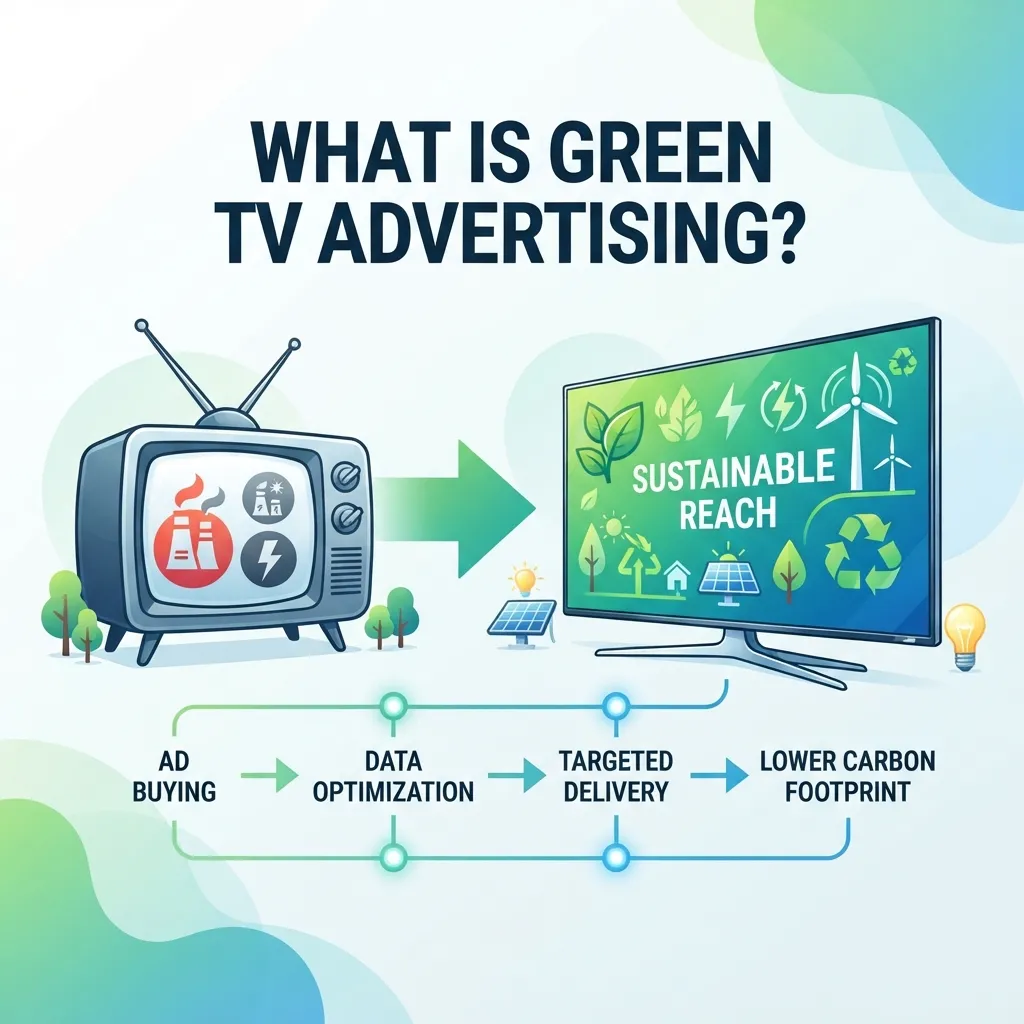
Green TV advertising refers to television advertising practices that reduce environmental impact across production, distribution, and media buying, combined with messaging that accurately reflects a brand’s genuine sustainability efforts. It is not simply advertising that mentions sustainability — a campaign can be visually “green” in its imagery while still being produced in a highly wasteful, carbon-intensive way, and conversely, a campaign can be produced sustainably without ever directly discussing environmental themes at all. Both scenarios are common in practice, and neither fully captures what green TV advertising is meant to achieve on its own.
Understanding this distinction is important because the two dimensions require different strategies. Reducing a campaign’s actual environmental footprint is largely an operational and logistical challenge, while communicating sustainability credibly is a messaging and brand trust challenge, and both need to be addressed for a green TV advertising effort to hold together.
The Environmental Footprint of Traditional TV Advertising
Television production and broadcasting carry a measurable environmental cost that often goes unexamined. Physical production involves travel, equipment transport, location logistics, set construction, and catering, each contributing to a campaign’s overall carbon footprint. Post-production, including rendering, color grading, and file transfers, adds further energy consumption, particularly for high-resolution or heavily processed footage. On the distribution side, broadcasting and streaming infrastructure also carries its own energy costs, scaling with the reach and frequency of a given media buy.
None of this makes television advertising uniquely worse than other media formats, but it does mean that “green” claims made within an ad ring somewhat hollow if the production and distribution process behind that ad wasn’t held to the same standard.
Strategies for Reducing the Footprint of TV Ad Production
Plan Efficient, Consolidated Shoots
Reducing the number of separate shoot days, locations, and equipment transports lowers both cost and environmental impact simultaneously. Batch-producing multiple ad variations or campaign assets during a single, well-planned shoot is one of the most straightforward ways to cut unnecessary travel and setup waste.
Choose Local Locations and Crews
Sourcing crew, talent, and equipment locally reduces the travel footprint associated with flying teams and gear across long distances. This approach often has the added benefit of supporting local production economies while cutting logistical costs.
Use Energy-Efficient Equipment
LED lighting, battery-powered or hybrid generators, and energy-efficient camera and editing equipment all reduce power consumption on set and in post-production, without compromising the visual quality of the final ad.
Digitize and Streamline Post-Production Workflows
Cloud-based collaboration and streamlined review processes reduce the need for physical media transport and redundant rendering passes, cutting both time and energy use during the editing and approval stages of a campaign.
Partner With Certified Sustainable Production Vendors
A growing number of production companies now offer sustainability certifications or carbon accounting for shoots, giving brands a way to measure and reduce the footprint of a specific campaign rather than relying on general estimates. Working with certified vendors also gives a brand a defensible, third-party-verified basis for any production-related sustainability claims it later chooses to make publicly, which matters considerably more than an internal, unverified estimate if those claims are ever questioned.
Strategies for Greener Media Buying
Production isn’t the only place sustainability decisions get made — media buying carries its own considerations:
- Right-size frequency and reach. Avoiding excessive ad frequency reduces both broadcast energy use and viewer fatigue, improving efficiency on both fronts simultaneously.
- Favor efficient formats and file specs. Delivering properly compressed, optimized files reduces the processing load required by broadcasters and streaming platforms.
- Work with broadcasters that report on sustainability. Some networks and streaming platforms now publish their own energy and emissions data, making it easier to factor a partner’s environmental practices into a media plan.
- Consolidate campaigns where possible. Running fewer, better-targeted campaigns instead of many small overlapping ones reduces redundant production and distribution work.
Thinking about efficiency at the media-buying stage connects closely with how television advertising is bought effectively overall, since many of the same principles that improve campaign efficiency also happen to reduce unnecessary environmental impact.
Crafting Credible Eco-Friendly Ad Messaging
Ground Claims in Specifics, Not Vague Language
Terms like “eco-friendly,” “green,” or “sustainable” carry little weight on their own. Specific, verifiable claims — a stated percentage reduction in emissions, a certified sourcing standard, a concrete recycling program — hold up far better under scrutiny than broad, feel-good language.
Avoid Nature Imagery as a Substitute for Substance
Leaning heavily on visual cues like forests, oceans, or green color palettes without backing those images with real practices is one of the most common patterns audiences now recognize as greenwashing. If a brand’s actual sustainability story is modest, an ad’s tone and claims should be equally modest rather than overselling.
Show, Don’t Just Tell
Demonstrating a specific sustainable practice — how a product is made, how packaging was redesigned, how a supply chain was changed — tends to be far more persuasive and credible than a general statement about caring for the planet.
Align Messaging With Broader Brand Behavior
An ad’s environmental claims need to match how the company operates outside of that specific campaign. Consistency between advertising and actual business practice is what separates credible green marketing from a brand that appears to be using sustainability purely as a temporary marketing angle, a principle worth applying to every industry-specific TV advertising approach, not just campaigns explicitly built around environmental themes.
Industries Where Green TV Advertising Carries Extra Weight
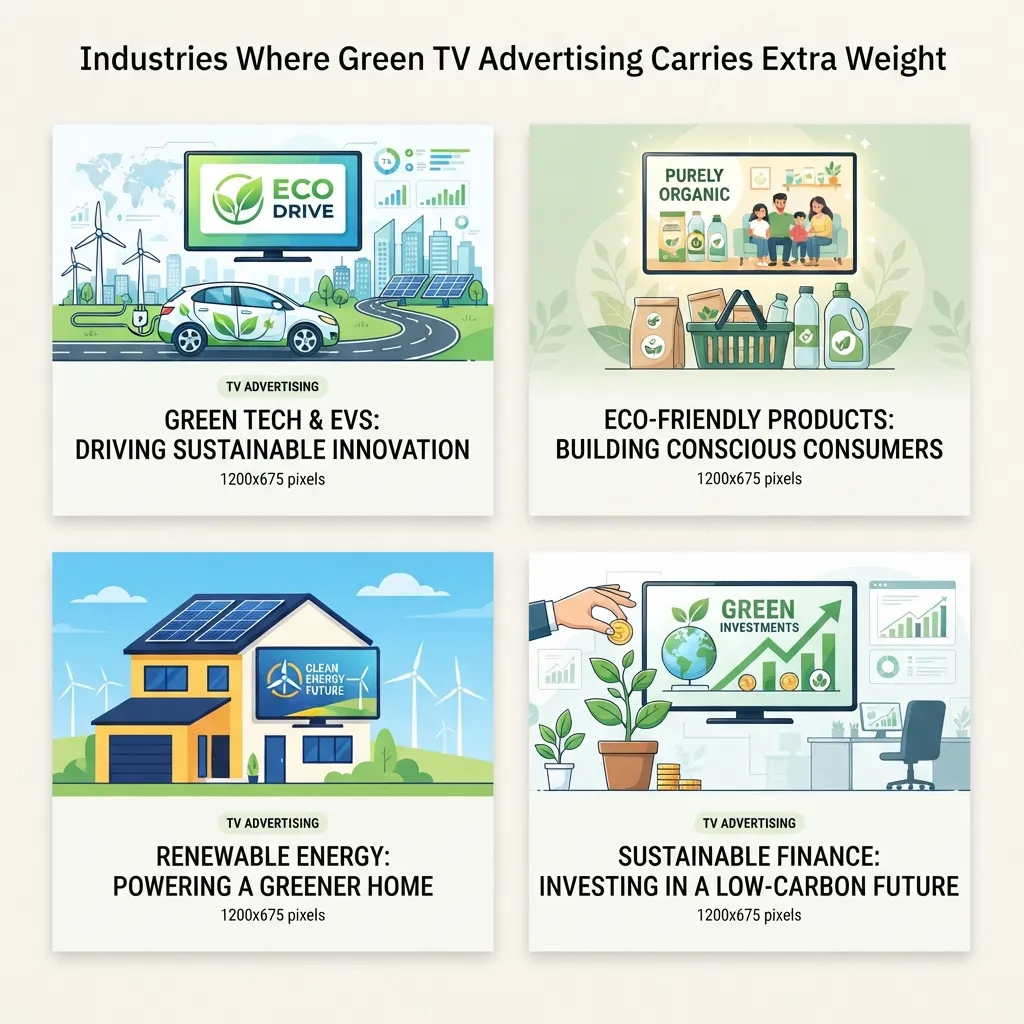
Certain industries face closer scrutiny of environmental claims and benefit from a particularly careful approach:
- Automotive brands promoting electric or hybrid vehicles need to substantiate efficiency and emissions claims clearly, especially as regulatory scrutiny of environmental marketing in this sector continues to increase.
- Energy and utilities companies face some of the highest skepticism around sustainability messaging, making transparent, specific claims especially important.
- Consumer packaged goods brands making recyclability or sourcing claims need packaging and supply chain practices that can withstand independent verification.
- Real estate and construction advertisers highlighting energy-efficient building practices benefit from citing measurable standards or certifications rather than general efficiency language.
Brands in these categories may also look to how real estate advertisers approach television campaigns more broadly for guidance on aligning message specificity with an already scrutiny-heavy audience.
Measuring the Impact of Green TV Advertising Efforts
A few measurement approaches help brands understand whether their green TV advertising strategy is working on both fronts, and tracking them consistently across campaigns — rather than treating each shoot as a one-off — is what turns sustainability from a marketing talking point into a measurable operational practice:
- Carbon accounting for production. Tracking estimated emissions from a shoot, post-production, and distribution provides a baseline to measure improvement against on future campaigns.
- Brand trust and sentiment tracking. Monitoring audience sentiment specifically around sustainability claims reveals whether messaging is landing as credible or being perceived as greenwashing.
- Comparative footprint across campaigns. Tracking the estimated footprint of each campaign over time shows whether production and media-buying changes are actually reducing impact.
- Standard advertising effectiveness metrics. Recall, favorability, and purchase intent still matter — a green TV advertising strategy needs to perform commercially, not just environmentally, to be sustainable as a business practice in its own right.
Measuring effectiveness alongside environmental impact echoes broader thinking found in eco-marketing trends aimed at increasingly sustainability-conscious consumers, where credibility and performance are treated as complementary goals rather than competing priorities.
Common Mistakes in Green TV Advertising
- Greenwashing through vague or unverifiable claims. Broad statements without evidence tend to damage trust more than making no environmental claim at all.
- Ignoring the production footprint while focusing only on messaging. A campaign can’t credibly claim sustainability if the production process behind it wasn’t held to any environmental standard.
- Overpromising relative to actual company practices. Messaging that outpaces real operational change creates a credibility gap that can resurface as a reputational risk later.
- Treating sustainability as a one-off campaign theme. A single “green” ad, disconnected from ongoing practice, tends to read as opportunistic rather than genuine.
- Failing to adapt messaging by audience and region. Environmental priorities and regulatory expectations vary significantly across markets, and a one-size-fits-all message can miss the mark or create compliance issues.
- Skipping legal and regulatory review. Environmental advertising claims are subject to increasing regulatory scrutiny in many regions, and skipping a compliance review before launch can turn a well-intentioned campaign into a legal liability.
The Future of Green TV Advertising
As environmental regulations around advertising claims continue to tighten in multiple markets, and as production technology continues to improve energy efficiency, green TV advertising is likely to shift from a differentiator to a baseline expectation. This shift is really just one thread within the broader work of future-proofing TV advertising strategy more generally, since sustainability now sits alongside targeting precision, format innovation, and measurement as a standard consideration for any forward-looking campaign plan. Advances in virtual production, remote collaboration tools, and more efficient broadcast and streaming infrastructure will likely continue lowering the operational footprint of TV campaigns generally, independent of any specific environmental messaging choice. Brands that build sustainable production and honest messaging practices into their standard workflow now, rather than treating green TV advertising as an occasional campaign concept, will be better positioned as scrutiny and regulation around environmental marketing claims continue to increase, similar to how broader video advertising strategy increasingly treats sustainability as one input among several rather than an isolated campaign theme.
Conclusion
Green TV advertising works best when it’s treated as two connected disciplines rather than one: reducing the real environmental footprint of producing and airing a campaign, and communicating sustainability honestly enough to withstand audience scrutiny. Brands that focus on only one side — a low-impact production paired with no environmental messaging at all, or a green-themed ad backed by an unchanged, high-footprint process — leave real value and credibility on the table. Getting both sides right takes deliberate planning, but it positions a brand to advertise sustainably in a way that holds up, both environmentally and reputationally, well beyond a single campaign cycle. The brands that treat this as an ongoing operational standard, rather than a one-time creative concept, are the ones most likely to see lasting trust benefits rather than a short-lived marketing bump.
Frequently Asked Questions
1. What is green TV advertising?
Green TV advertising refers to television advertising practices that reduce environmental impact across production and media buying, combined with messaging that accurately reflects real sustainability efforts.
2. Does green TV advertising just mean ads about environmental topics?
No. It covers both the environmental footprint of producing and airing a campaign and the accuracy of any sustainability messaging within the ad itself.
3. What is greenwashing in TV advertising?
Greenwashing is the use of vague, exaggerated, or unverifiable environmental claims in advertising that do not reflect a brand’s actual practices.
4. How can brands reduce the carbon footprint of TV ad production?
Consolidating shoots, sourcing local crews, using energy-efficient equipment, and streamlining post-production workflows can help reduce a campaign’s environmental impact.
5. Which industries face the most scrutiny around green TV advertising claims?
Automotive, energy and utilities, consumer packaged goods, and real estate advertisers tend to face closer scrutiny of environmental claims.
6. How do you make eco-friendly ad messaging credible?
Using specific, verifiable details rather than vague language and aligning claims with a brand’s actual practices can improve credibility.
7. Can media buying decisions affect a TV campaign’s environmental impact?
Yes. Decisions involving ad frequency, file optimization, and the choice of broadcast partner can influence a campaign’s broader environmental footprint.
8. Is green TV advertising more expensive than traditional advertising?
Not necessarily. Sustainability-focused practices, such as consolidated shoots and efficient equipment, can sometimes reduce overall production costs.
9. How do you measure the success of a green TV advertising campaign?
Carbon accounting for production, sentiment tracking around sustainability claims, and standard advertising metrics such as recall and purchase intent can all be considered.
10. Should every TV ad include environmental messaging?
No. Sustainability messaging should be relevant to the campaign and supported by genuine environmental practices rather than being added simply for appearance.
11. What’s the risk of overstating sustainability claims in a TV ad?
Overstated claims can create a credibility gap and damage brand trust when audiences or regulators compare advertising messages with actual company practices.
12. Is green TV advertising becoming a regulatory requirement?
In several markets, regulations around environmental advertising claims are becoming stricter, making accurate and substantiated messaging increasingly important.