TV advertising is entering a new era shaped by connected TV, programmatic buying, addressable targeting, and AI-driven personalization. This guide breaks down the trends reshaping the industry and gives brands practical strategies to keep their campaigns relevant, measurable, and profitable for years to come.
For decades, TV advertising was built around a simple formula: buy a slot during a popular show, run the same spot for millions of viewers, and hope the message landed. That formula still has value, but it no longer describes the whole picture. Streaming, addressable set-top boxes, programmatic marketplaces, and artificial intelligence have all changed how audiences watch television and how advertisers reach them.
Brands that treat TV advertising as a static, “set it and forget it” channel are already falling behind. Those that treat it as an evolving ecosystem — one that blends the emotional reach of traditional broadcast with the precision of digital marketing — are the ones winning attention and budget. This article looks at where the channel is headed, the forces driving that change, and the concrete steps marketers can take to future-proof their strategy.
If you’re building out a broader plan, it helps to first understand the fundamentals covered in our television advertising complete guide before diving into the trends below.
Why Future-Proofing TV Advertising Matters Now
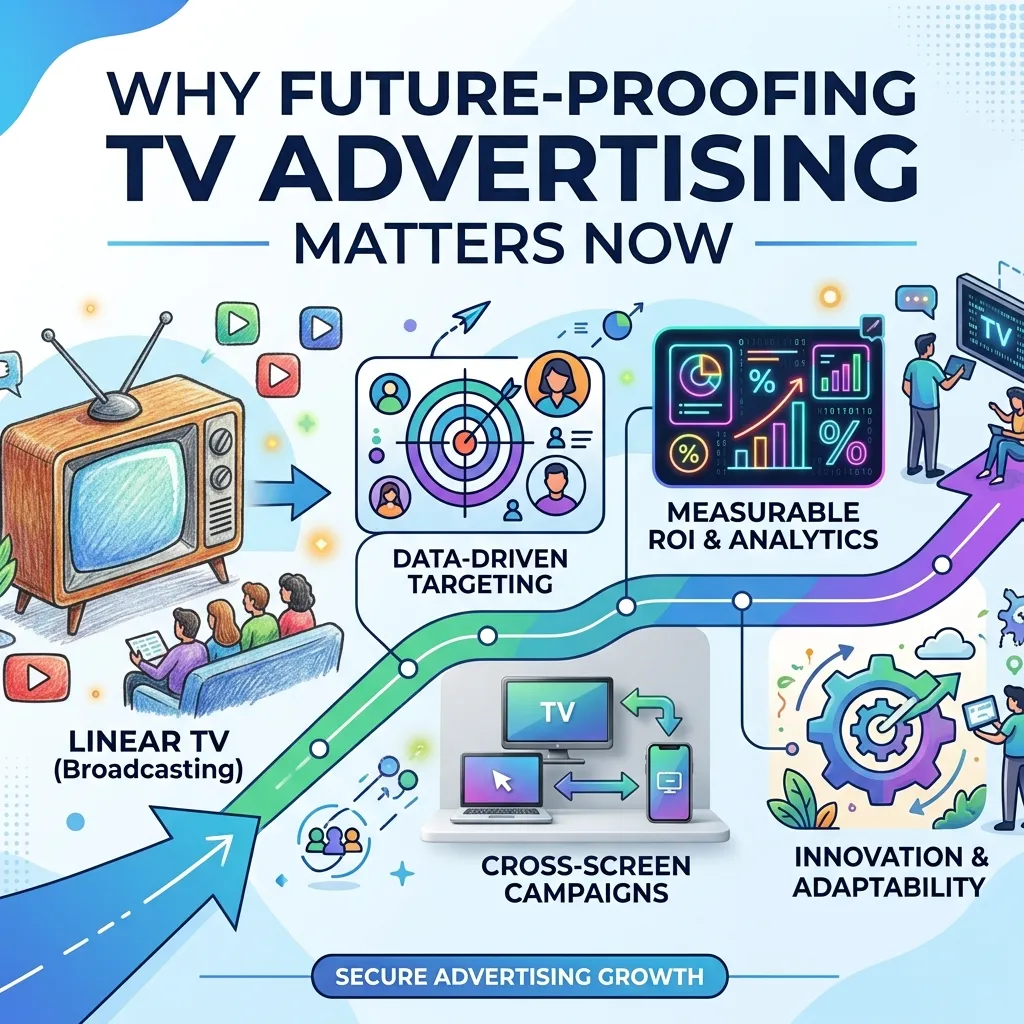
Viewing habits have fragmented. A single household might watch live sports on cable, a drama series on a streaming app, and short clips on a connected device — all on the same television screen, sometimes within the same evening. This fragmentation means a single campaign strategy can no longer reach every viewer through one pipe.
At the same time, budgets are under more scrutiny than ever. Finance teams want to see how this spend translates into measurable outcomes, not just reach and frequency. That pressure has pushed the industry toward better attribution, real-time optimization, and audience-level targeting — capabilities that were once exclusive to digital channels.
Future-proofing this channel, then, isn’t about chasing every new buzzword. It’s about building a strategy flexible enough to absorb new formats, new measurement standards, and new viewer behaviors without requiring a complete overhaul each time the landscape shifts. Advertisers who understand how much television advertising costs today are in a much stronger position to negotiate and plan for tomorrow’s inventory.
Key Trends Reshaping TV Advertising
1. Connected TV Is the New Prime Time
Connected TV (CTV) — television advertisement delivered through internet-connected devices and smart TVs — has moved from a niche experiment to a mainstream buying channel. Viewers are spending more time with streaming apps than with traditional linear schedules, and advertisers are following that attention. Unlike classic broadcast slots, CTV inventory is typically sold with digital-style targeting, giving TV advertising the audience precision that used to belong only to social platforms.
For brands new to this space, our breakdown of connected TV advertising strategies for success walks through how to structure a first CTV buy without wasting spend on overlapping audiences.
2. Addressable Advertising Narrows the Target
Addressable TV advertising lets brands serve different creative to different households watching the exact same program, based on data like location, purchase history, or demographics. This is a meaningful shift from the “one ad, every viewer” model of traditional broadcast, and it’s one of the clearest signs that the line between broadcast and digital marketing is disappearing.
Marketers who want the mechanics behind this shift should review addressable TV advertising strategies, which covers data requirements, minimum audience thresholds, and how addressable buys typically get priced against standard broadcast slots.
3. Programmatic Buying Adds Speed and Control
Programmatic advertising — the practice of using automated software rather than manual insertion orders to buy media — has expanded well beyond banner ads. Programmatic TV lets buyers set targeting parameters, budgets, and pacing rules, then let the platform optimize delivery in near real time. This is a major departure from legacy broadcast buying, where a slot was locked in weeks or months ahead with limited room to adjust mid-flight.
Our guide to programmatic TV advertising strategies explains the bidding mechanics in more detail, and the companion piece on data-driven programmatic and addressable TV ads shows how the two approaches often work together in a single campaign.
4. Artificial Intelligence Personalizes the Viewer Experience
AI now plays a role in nearly every stage of a TV advertising campaign — from predicting which creative variant will perform best with a given segment, to automatically adjusting bids in a programmatic marketplace, to generating localized versions of a national spot. Because AI systems can process viewing and purchase signals far faster than a human planner, they’re becoming essential to running campaigns at scale without ballooning agency costs.
Readers exploring this trend in depth may want to see harnessing AI in TV advertising personalization for examples of how brands are using machine learning to tailor messaging by region, weather, or even time of day.
5. Interactivity Turns Passive Viewers Into Active Participants
Smart TVs and streaming apps increasingly support interactive overlays — QR codes, shoppable banners, or remote-triggered actions — that let viewers respond to an ad without picking up a second device. This closes a long-standing gap in TV advertising: the inability to measure or capture an immediate response the way a digital ad can.
For a closer look at formats that are performing well right now, see interactive TV advertising for modern engagement.
6. Sustainability Becomes a Planning Criterion
Production waste, energy-intensive ad tech infrastructure, and carbon-heavy broadcast operations are now part of the conversation when brands plan a campaign. Some advertisers are choosing production partners and delivery platforms specifically because they can document a lower environmental footprint, treating sustainability as a brand-safety issue as much as an ethical one.
Our piece on eco-friendly TV ads and sustainable campaign strategy covers practical ways to lower a campaign’s footprint without cutting production quality.
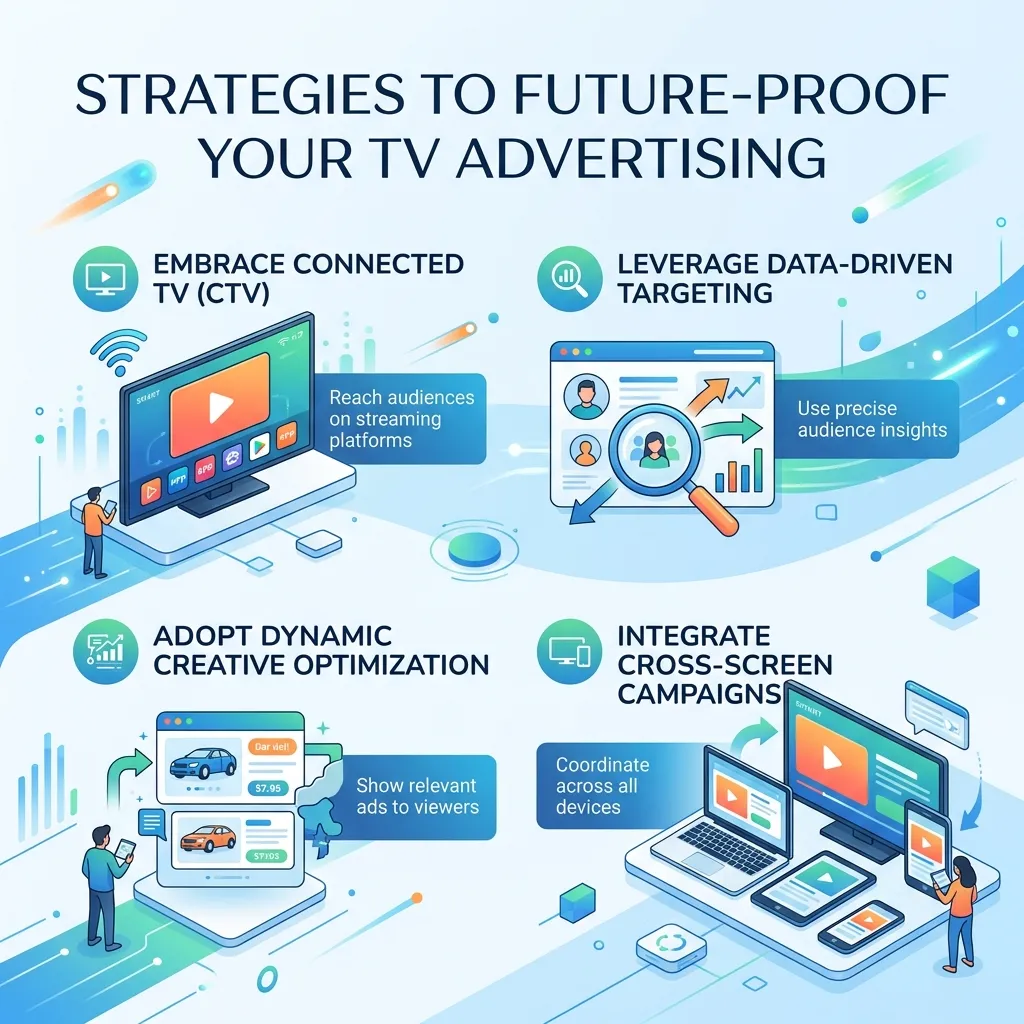
Strategies to Future-Proof Your TV Advertising
Diversify Across Linear, CTV, and Addressable Inventory
Relying on a single buying method leaves a media strategy exposed if that channel’s costs rise or its audience shrinks. A blended approach — some linear reach for mass awareness, some CTV and addressable inventory for precision — tends to be more resilient than betting everything on one format.
Build a First-Party Data Foundation
The targeting advantages of addressable and programmatic buying depend on data quality. Brands that invest early in first-party data collection — loyalty programs, CRM records, app engagement — have far more flexibility when new privacy regulations or platform changes limit third-party targeting options.
Treat Creative as a Variable, Not a Constant
Traditional broadcast campaigns often ran a single 30-second cut for the length of a flight. Future-proofed strategies instead produce several creative variants designed to be tested and swapped based on performance data, which is now realistic because of programmatic delivery. This is closely tied to how a television ad that captivates is put together in the first place — strong creative fundamentals still matter, no matter how advanced the targeting gets.
Invest in Measurement That Matches Modern Buying
Legacy reach-and-frequency metrics still matter, but they don’t tell the whole story anymore. Brands need attribution models that can tie broadcast exposure to website visits, app installs, or in-store sales, especially as more inventory is bought on an audience basis rather than a program basis. Understanding how effective television advertisements really are requires this kind of multi-touch view rather than relying on gross rating points alone.
Plan Budgets With Flexibility Built In
Locking 100% of a media budget into upfront linear commitments removes the ability to shift spend toward better-performing formats mid-campaign. Holding back a portion of budget for programmatic and addressable buys gives planners room to react to real-time performance data.
Keep an Eye on Cost Trends by Format
Pricing for CTV, addressable, and traditional broadcast doesn’t move in lockstep — one format can get more expensive while another holds steady or drops. Reviewing cable television advertising cost trends periodically helps ensure a media plan isn’t overpaying for inventory that has a cheaper, equally effective alternative.
Measuring the ROI of a Future-Proofed Campaign
Future-proofing only matters if it improves outcomes. That means every new format or targeting method added to a media plan should be tied to a measurable goal — brand lift, website traffic, app downloads, or direct sales — rather than adopted simply because it’s new. A useful starting point is our ROI guide to whether TV advertising works, which lays out the metrics worth tracking at each stage of a campaign.
It’s also worth revisiting foundational questions periodically. Is the audience still watching the way they were a year ago? Has TV advertising still proven effective for this specific product category? Markets and viewing habits shift quickly enough that assumptions from even twelve months ago may need to be re-tested.
Industry-Specific Considerations
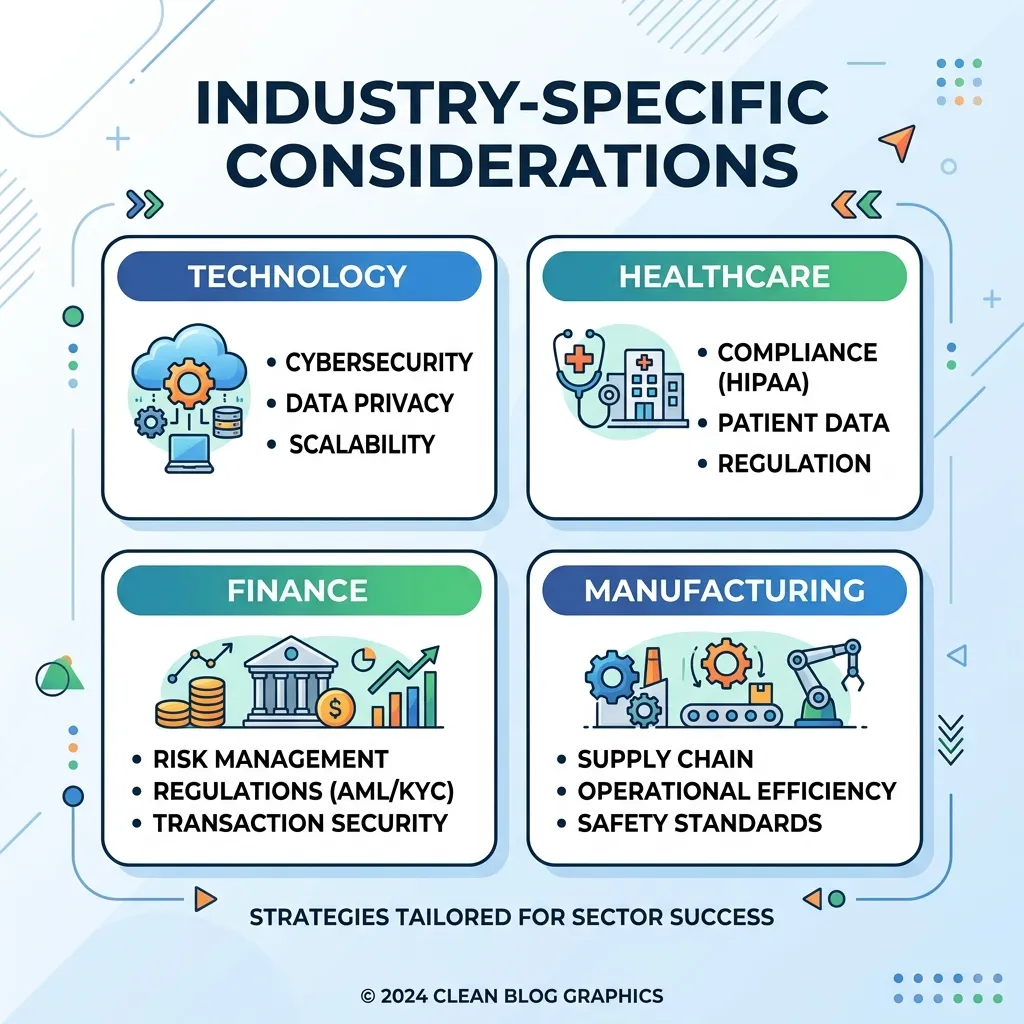
Future-proofing looks different depending on the category. A law firm running TV ads has very different creative and compliance needs than a restaurant advertising on TV or a real estate brand’s TV ad strategy. Reviewing how different sectors approach the medium in our breakdown by industry is a helpful way to benchmark a plan against category norms rather than generic best practices.
Conclusion
TV advertising isn’t disappearing — it’s diversifying. The brands that will get the most from the channel over the next several years aren’t the ones chasing every new format the moment it appears, but the ones building strategies flexible enough to absorb connected TV, addressable targeting, programmatic buying, and AI-driven personalization as they mature. That means investing in first-party data, treating creative as something to test rather than set once, and holding measurement standards that match how it’s actually bought and delivered today.
Future-proofing this strategy is less about predicting exactly what comes next and more about building the operational habits — flexible budgets, diversified inventory, and rigorous measurement — that let a brand adapt quickly whenever the next shift arrives. According to the Wikipedia entry on television advertisements, the format has continually evolved since its introduction, and that pattern of change shows no sign of slowing down.
Frequently Asked Questions About Future-Proof TV Advertising
What does “future-proofing” mean in the context of TV advertising?
It means building a media strategy that can adapt to new formats, targeting methods, and measurement standards without requiring a complete redesign every time the industry shifts — for example, being ready to shift budget between linear, connected TV, and addressable inventory as viewing habits change.
Is traditional linear TV advertising still worth investing in?
Yes. Linear broadcast still delivers strong reach for mass-awareness goals, especially around live sports and major broadcast events. Most future-proofed strategies blend linear with connected TV and addressable buys rather than abandoning linear entirely.
What’s the difference between connected TV and addressable TV advertising?
Connected TV refers to advertising delivered through internet-connected devices and streaming apps. Addressable TV advertising is a targeting method that can be used within CTV or on traditional cable, allowing different households watching the same program to see different ads.
How does programmatic buying change a TV advertising campaign?
Programmatic advertising automates the buying process, letting advertisers set targeting and budget rules and adjust delivery in near real time, instead of locking in a fixed schedule months in advance the way traditional broadcast has historically worked.
Does AI actually improve TV advertising performance?
AI helps process viewing and purchase data faster than manual planning allows, which supports better creative selection, bid optimization, and audience segmentation. Its impact depends on the quality of the data feeding it, so a solid data foundation matters more than the AI tool itself.
How is TV advertising measured differently today compared to a decade ago?
Traditional metrics like reach and frequency are now often paired with digital-style attribution — tracking website visits, app installs, or sales lift tied to specific ad exposures — especially for campaigns bought on an audience basis rather than a program basis.
What role does first-party data play in future-proofing a TV advertising strategy?
First-party data from CRM systems, loyalty programs, or app usage gives advertisers more control over addressable and programmatic targeting and reduces dependence on third-party data sources that may become restricted by future privacy rules.
Are interactive TV ads worth the added production cost?
For campaigns focused on direct response — driving purchases, sign-ups, or app downloads — interactive formats can close the gap between a passive TV ad and a trackable action. For pure brand-awareness campaigns, the added cost may not be necessary.
How often should a brand review its TV advertising strategy?
At minimum annually, though categories with fast-changing viewing habits or heavy streaming adoption may benefit from a semi-annual review of format mix, targeting data, and creative performance.
Does sustainability actually affect TV advertising decisions?
For a growing number of brands, yes. Production choices and ad-tech partners are increasingly evaluated on environmental footprint alongside cost and reach, particularly for companies whose broader marketing already emphasizes sustainability commitments.
Is addressable TV advertising only available to large brands with big budgets?
No. Addressable inventory is increasingly accessible to small and mid-sized advertisers through self-serve platforms and local cable providers, though minimum audience thresholds and data requirements still vary by market.
What’s the biggest mistake brands make when trying to future-proof their TV advertising?
Treating every new format as mandatory. The more common and costly mistake is spreading a budget too thin across every emerging channel instead of testing new formats against clear, measurable goals before scaling them up.