
Advertising plays an important role in helping businesses reach customers, build brand awareness, and increase sales. Today, companies can choose between traditional advertising methods, such as television commercials, and digital marketing channels, including social media, search engines, email, and websites. For an online business, choosing the right advertising strategy depends on its budget, target audience, marketing goals, and available resources. Television advertising can deliver broad exposure and build trust, while digital advertising offers precise targeting, flexible budgets, and measurable results. Understanding the differences between these approaches helps businesses develop effective marketing campaigns and achieve sustainable growth.
TV Advertising vs. Online Advertising
Television advertising and online advertising are two popular methods of promoting products and services. Television advertising uses commercials broadcast during television programs, live events, and other scheduled content. Online advertising uses internet-based platforms, including search engines, websites, social media networks, and video-sharing platforms, to connect businesses with potential customers.
For an online business, the main difference between these methods is how audiences discover and interact with advertisements. Television commercials generally reach viewers through scheduled programming, whereas online advertisements can appear when users search for products, browse social media, or watch videos. Digital campaigns also allow businesses to adjust their targeting based on customer interests, location, and browsing behavior.
Television advertising can be particularly useful for introducing a new brand to a large audience. A well-produced commercial can communicate a message through visuals, sound, and storytelling. However, online advertising allows marketers to monitor impressions, clicks, conversions, and other performance indicators. Businesses can use these insights to improve campaigns and allocate their budgets more effectively.
The best option depends on the company’s objectives. Businesses seeking widespread recognition may benefit from television exposure, while companies looking for direct website traffic and measurable conversions may prefer digital channels. An online business can also combine both methods to strengthen brand awareness and encourage customers to take action.
Traditional Advertising vs. Digital Marketing
Traditional advertising includes television, radio, newspapers, magazines, billboards, and printed promotional materials. Digital marketing involves online channels such as search engine optimization, paid search, social media marketing, email campaigns, and content marketing.
Traditional advertising often focuses on reaching a broad audience within a particular region or market. It can be effective for businesses with products that appeal to a wide range of consumers. However, measuring the direct impact of traditional campaigns can be challenging because exposure does not always translate into identifiable purchases.
Digital marketing provides more opportunities for interaction and performance tracking. Businesses can analyze campaign results, identify customer preferences, and modify their messages according to audience responses. For an online business, these capabilities can make marketing more flexible and accountable.
For example, a company selling clothing online can use search advertisements to reach customers looking for specific products. It can also publish useful content, improve its website, and send personalized emails to interested subscribers. Businesses that want to improve customer retention can explore email marketing automation to understand how automated communication supports customer relationships and repeat purchases.
Traditional advertising still has value, particularly when credibility, local awareness, or large-scale exposure is important. Digital marketing, however, provides practical tools for businesses that want to reach specific audiences and measure their marketing performance.
Television Advertising Advantages and Disadvantages
 Television advertising offers several advantages for companies seeking greater visibility. Television combines moving images, sound, music, and storytelling to create memorable promotional messages. Advertisements shown during popular programs or major sporting events may reach substantial audiences in a short period.
Another advantage is the potential to build brand recognition. Repeated exposure to a consistent advertising message can help consumers remember a company and recognize its products. For an online business, television advertising may introduce the brand to people who have not discovered it through internet searches or social media.
Nevertheless, television advertising has disadvantages. Producing professional commercials and purchasing airtime can require substantial investment. National campaigns are particularly expensive, and smaller companies may struggle to compete with established brands. Television advertisements also offer limited opportunities for immediate interaction compared with digital platforms.
Measuring direct sales attributable to a television campaign can be difficult. Although businesses can use dedicated website addresses, promotional codes, surveys, and changes in branded searches to estimate results, these methods do not always capture the entire effect.
Businesses should therefore evaluate their budgets and objectives before investing. Television may be suitable for companies with sufficient resources and broad marketing goals, but smaller organizations may achieve better initial results through more affordable digital channels.
Digital Advertising Benefits for Businesses
Digital advertising enables businesses to promote products and services through search engines, social networks, display advertisements, online videos, and other internet-based platforms. One of its biggest benefits is audience targeting. Advertisers can reach users according to factors such as location, interests, search intent, and other permitted audience characteristics.
For an online business, this flexibility makes it possible to focus spending on people who are more likely to become customers. A company selling home accessories, for example, can advertise specific products to users searching for related items rather than paying to reach an entire television audience.
Digital advertising also supports budget control. Businesses can start with relatively small campaigns, compare results, and increase spending when performance justifies the investment. They can test different headlines, images, offers, and landing pages to discover which combinations produce better results.
Another benefit is the ability to track performance. Metrics such as click-through rate, conversion rate, customer acquisition cost, and return on advertising spend help marketers understand how campaigns contribute to business objectives.
Companies operating in online retail can also learn from e-commerce marketing strategies, which cover approaches for attracting customers and promoting online stores. When supported by useful content, a clear website, and a reliable purchasing process, digital advertising can become an important part of a sustainable growth strategy.
TV Ads vs. Social Media Ads
Television advertisements and social media advertisements differ in their audience reach, interaction opportunities, and measurement methods. Television commercials typically communicate a message to viewers watching particular programs. Social media advertisements appear within platforms where users watch videos, follow creators, communicate with others, and discover products.
Television can provide strong visual storytelling and broad exposure. A compelling commercial may make a product recognizable to consumers across different age groups. However, viewers generally cannot interact directly with the advertisement itself.
Social media advertising encourages more immediate engagement. Depending on the platform and campaign format, users may click a product link, visit an online store, watch a demonstration, comment on a post, or share content with others. Businesses can also use different creative formats to appeal to particular audiences.
For an online business, social media can be especially useful when the objective is to generate website visits, product inquiries, or purchases. A small company can test several advertisements and compare their results without committing to a large television advertising budget.
However, social media performance depends on creative quality, audience relevance, competition, and platform changes. Television campaigns can also be affected by program selection and viewing habits. Rather than assuming that one channel always performs better, businesses should compare the actual results against their marketing objectives.
Cost of TV Advertising vs. Digital Advertising
The cost of advertising varies according to the market, audience, campaign duration, production requirements, and competition for advertising space. Television advertising may involve commercial production, talent, editing, media placement, and repeated airtime purchases. National television campaigns generally require larger budgets than campaigns targeting smaller geographic areas.
Digital advertising can often be launched with a more flexible budget. Businesses may pay according to clicks, impressions, video views, or other campaign objectives. However, low starting costs do not guarantee inexpensive sales. Competitive keywords, expensive audiences, poor conversion rates, and weak landing pages can increase the cost of acquiring customers.
An online business should calculate the total cost of a campaign rather than considering advertising fees alone. Website development, creative production, staff time, analytics tools, and customer service may also contribute to marketing expenses.
For example, a business might spend a small amount on social media advertising and generate several sales, while another company spends more without producing profitable results. The difference may come from targeting, product demand, pricing, and the customer experience rather than the advertising channel itself.
A useful approach is to establish a clear budget, define a measurable goal, and evaluate campaign performance regularly. Businesses can then increase investment in the channels that deliver sustainable returns instead of choosing advertising methods based solely on their initial prices.
Digital Marketing vs. Traditional Media
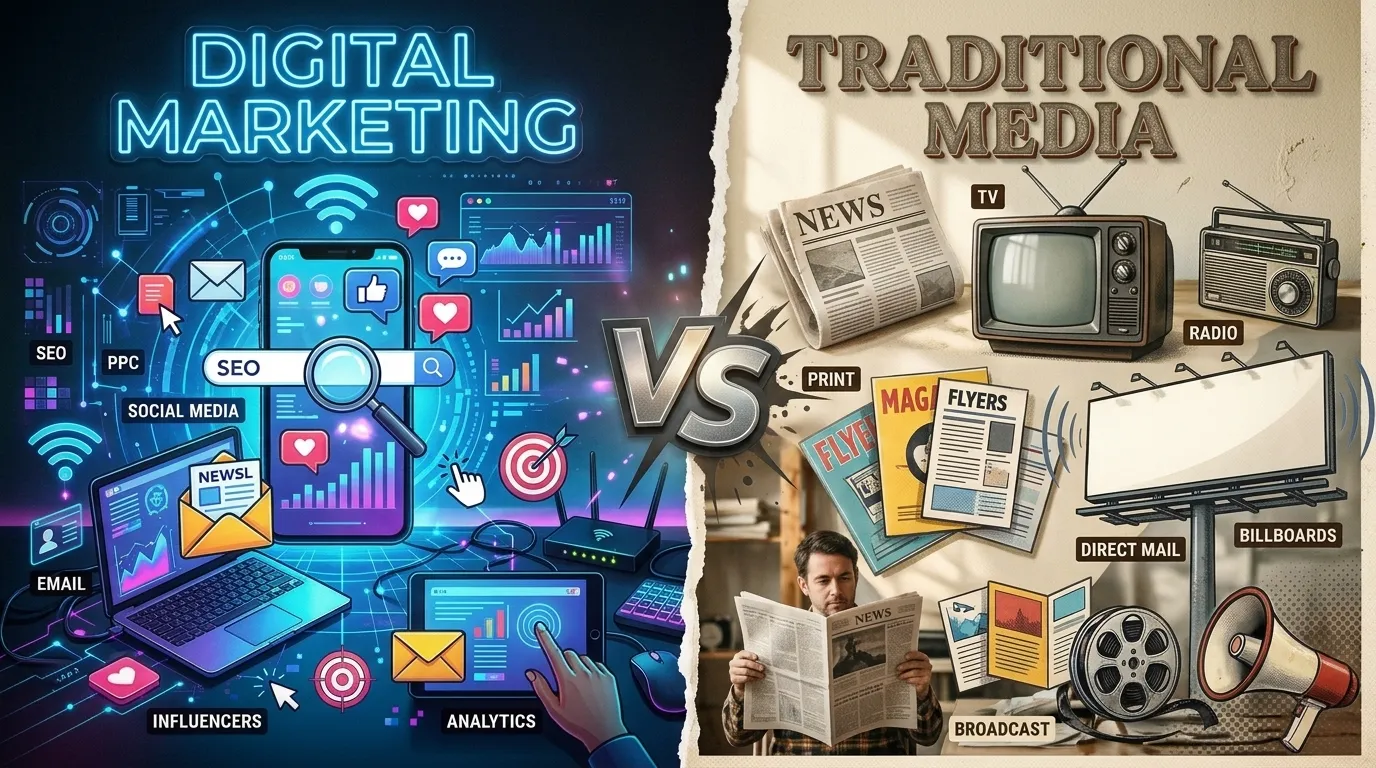 Digital marketing and traditional media serve different but sometimes complementary purposes. Traditional media, including television, radio, print publications, and outdoor advertising, can help businesses reach audiences through established communication channels. Digital marketing enables businesses to communicate through websites, search engines, social platforms, and email.
The major distinction is the level of measurement and interaction available. Traditional media often provides broad exposure, while digital channels generally offer more detailed reporting on audience behavior. Digital campaigns can also be updated quickly when customer preferences or business priorities change.
For an online business, digital marketing supports activities throughout the customer journey. Search engine optimization can help people discover useful website content, social media can introduce products, and email can maintain communication with existing customers.
Companies interested in expanding their marketing efforts can also explore business growth strategies to understand how marketing, customer relationships, and operational planning contribute to long-term success. Nevertheless, traditional media should not be dismissed. A television commercial may introduce a company to a wide audience, while digital advertising helps interested viewers find the website and learn more. Using several coordinated channels can create a more consistent customer experience than relying on a single medium.
TV Advertising Effectiveness Compared to Digital Ads
Advertising effectiveness depends on the results a company wants to achieve. Television advertising may be effective for building awareness, introducing a new product, and communicating a memorable brand message. Digital advertisements can be effective for generating website traffic, attracting qualified leads, and encouraging measurable customer actions.
Businesses should distinguish between exposure and conversion. A television commercial may reach many viewers without producing immediate purchases, yet it may influence future brand recognition. Similarly, a digital advertisement may generate numerous clicks but few sales if the website is confusing or the offer does not meet customer expectations.
An online business can evaluate effectiveness using several measures. Brand awareness surveys, website traffic, lead generation, conversion rates, and customer acquisition costs provide different perspectives on campaign performance. Comparing these metrics over time helps marketers understand whether their advertising investments are producing meaningful results.
For businesses considering television campaigns, the benefits of TV advertising provide further context about television’s potential role in brand promotion. Companies seeking wider geographic exposure can also review national TV advertising to learn more about campaigns aimed at audiences across a country. Ultimately, the most effective advertising channel is the one that contributes to clearly defined business goals at an acceptable cost. Testing, tracking, and continuous improvement are more reliable than assuming that one advertising method will outperform every alternative.
Targeted Advertising vs. Mass Media Advertising
Targeted advertising focuses on reaching a defined audience, while mass media advertising aims to expose a message to a large group of people. Digital platforms often support targeted campaigns using relevant audience signals, location settings, interests, and search behavior, subject to platform policies and privacy requirements.
Mass media advertising, including television commercials, can be valuable when a business wants to build widespread recognition. Products with broad appeal may benefit from exposure across a large audience, even if not every viewer is an immediate potential customer. Targeted advertising can help businesses use their budgets more efficiently by prioritizing audiences that are likely to be interested in their offers. However, overly narrow targeting may limit reach, increase advertising costs, or exclude potential customers.
For an online business, a balanced approach often works best. A company may use broad campaigns to introduce its brand and more targeted campaigns to reach people searching for specific products. It can also create different advertisements for new visitors and existing customers, provided the approach respects privacy requirements and applicable advertising rules. The appropriate balance depends on the product, customer base, market size, and available budget. Businesses should test their assumptions and use campaign data to refine their audience strategies over time.
Best Advertising Strategy for Businesses
 The best advertising strategy combines a clear understanding of customers with realistic goals, suitable marketing channels, and consistent performance measurement. There is no single method that works equally well for every company. A local service provider, a national retailer, and an online store may need very different approaches.
An online business should begin by identifying its ideal customers and understanding where they discover products, research options, and make purchasing decisions. It should then select channels that match those behaviors. Search advertising can reach people with strong purchase intent, social media can introduce products to new audiences, and email marketing can help maintain customer relationships.
Businesses should also establish specific objectives before launching campaigns. These may include increasing brand awareness, generating qualified leads, improving website traffic, or increasing profitable sales. Each objective requires appropriate performance measures.
Companies with larger budgets may combine television and digital advertising. Television can create broad awareness, while digital channels help customers find product information, visit websites, and complete purchases. Smaller companies may choose to begin with search engine optimization, social media, content marketing, and carefully managed paid campaigns before expanding into more expensive media.
Long-term success requires more than advertising alone. A business needs a reliable website, competitive products, transparent pricing, useful content, responsive customer service, and a straightforward purchasing process. The profitable online business ideas resource may also help readers explore business opportunities that can be promoted through suitable marketing channels. By reviewing campaign results, learning from customer feedback, and adjusting budgets according to performance, businesses can build an advertising strategy that supports sustainable growth.
Conclusion
Choosing between television advertising and digital marketing requires a clear understanding of business goals, audience preferences, and available resources. Television remains valuable for broad reach and brand storytelling, while digital advertising offers flexible budgets, targeted campaigns, and measurable results. For many companies, combining these methods can provide a balanced approach to marketing. By testing campaigns, monitoring performance, and prioritizing customer needs, businesses can develop an advertising strategy that supports long-term growth and profitability.
FAQ
1. What is the main difference between TV advertising and online advertising?
TV advertising delivers commercials through television programming, while online advertising uses internet platforms such as search engines, websites, and social media. Online advertising generally offers more detailed performance tracking and audience targeting.
2. Is digital advertising cheaper than television advertising?
Digital advertising often has a lower starting cost and more flexible budgeting options. However, the actual cost depends on competition, campaign quality, targeting, and the results a business wants to achieve.
3. Is television advertising still effective?
Yes. Television advertising can support brand awareness, product launches, and broad audience reach. Its effectiveness depends on the target audience, commercial quality, placement, and campaign objectives.
4. Which advertising method is best for a small business?
Small businesses often benefit from search engine optimization, social media marketing, and targeted digital advertising because these channels can be tested with flexible budgets. The best choice depends on customer behavior and business goals.
5. Can businesses use television and digital advertising together?
Yes. Television can introduce a brand to a broad audience, while digital marketing can help interested consumers find more information, visit a website, and make purchases.
6. How can businesses measure advertising effectiveness?
Businesses can measure website traffic, conversions, lead generation, customer acquisition costs, return on advertising spend, and changes in brand awareness. The appropriate metrics depend on campaign objectives.
7. Why is targeted advertising useful?
Targeted advertising helps businesses reach audiences who are more likely to be interested in their products or services. It can improve relevance and reduce wasted spending when targeting is designed carefully.
8. Are social media advertisements better than TV commercials?
Neither method is universally better. Social media advertising offers interaction and detailed tracking, while television advertising can provide broad exposure and memorable storytelling. The right option depends on the intended outcome.
9. How much should a business spend on advertising?
A business should set its budget according to its financial resources, growth objectives, profit margins, and customer acquisition targets. Starting with a manageable budget and reviewing results can help guide future spending.
10. What is the best advertising strategy for an online business?
A strong strategy combines suitable digital channels, valuable content, audience research, clear offers, and regular performance analysis. Businesses with appropriate budgets may also incorporate television advertising to increase brand awareness.