Television advertising remains an effective way for businesses to build brand awareness, connect with their target audience, and promote products or services. A successful television advertisement requires more than an attractive video. It involves creative planning, scriptwriting, professional filming, editing, sound design, and strategic distribution. Understanding the TV Commercial Production Process helps businesses create advertisements that communicate their message clearly and leave a lasting impression on viewers. From the initial concept to the final broadcast, every production stage plays an important role in achieving the desired results. Whether a company wants to introduce a new product, increase sales, or strengthen its market position, professional commercial production can turn its marketing ideas into engaging visual stories.
TV Commercial Production Stages
Creating a television advertisement involves several connected stages that transform an initial idea into a polished commercial. Each stage requires careful attention because the quality of the final advertisement depends on how effectively the entire production is managed. The TV Commercial Production Process generally begins with research and creative development before moving into pre-production, filming, post-production, and final delivery. The first stage focuses on understanding the business, its products, and its advertising objectives. Production teams work with clients to identify the main message, target audience, brand personality, and expected outcomes. This information helps creative professionals develop an advertising concept that connects with viewers.
Once the concept is approved, the production team prepares the script, visual direction, shooting schedule, and production budget. Filming follows the planning stage, where actors, directors, camera operators, and other professionals work together to capture the required footage. Finally, editors combine the footage with music, voiceovers, graphics, and visual effects to create the finished advertisement. A well-managed TV Commercial Production Process ensures that every production stage supports the same creative vision. It also helps businesses maintain consistency, manage costs, and deliver advertisements that meet professional broadcasting standards.
Television Advertisement Production Process
The television advertisement production process begins with a clear understanding of what a business wants to communicate. An advertisement should have a specific purpose, whether that is introducing a product, promoting a limited-time offer, building trust, or encouraging customers to take action. Market research is an important part of this process. Businesses need to understand their audience’s interests, purchasing behavior, preferences, and problems. This information allows creative teams to develop advertising messages that are relevant to potential customers.
After completing the research, the production team develops the main concept and determines how the advertisement will communicate its message. A strong television commercial usually combines storytelling, memorable visuals, appropriate music, and a clear brand identity. The TV Commercial Production Process also requires effective communication between the client, creative director, production company, and marketing team. Businesses should consider how television advertising fits into their broader marketing strategy. For example, a television campaign can support a larger marketing campaign by maintaining consistent messaging across different advertising channels. Combining television exposure with online marketing can help businesses reach customers at multiple stages of their buying journey.
TV Commercial Video Production
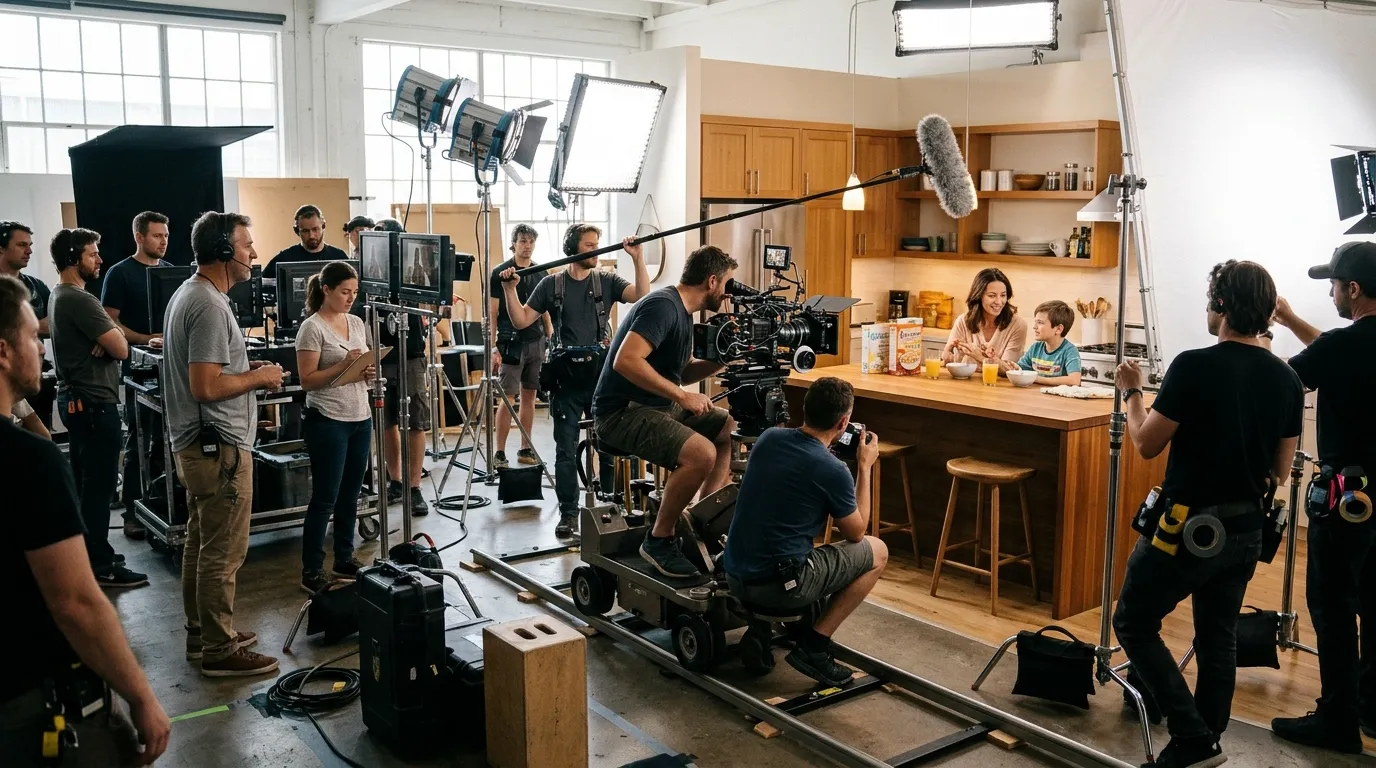 TV commercial video production is the stage where the creative concept becomes a visual experience. It requires professional equipment, experienced production staff, suitable locations, and a clear understanding of the advertisement’s intended style. The visual quality of a commercial has a significant influence on how audiences perceive a brand. Professional camera work, lighting, framing, and composition help create an attractive and credible advertisement. Even a short television commercial needs careful visual planning to ensure that every scene contributes to the main message.
During this stage, directors guide the overall creative presentation, while cinematographers manage camera movements, angles, and lighting. Production assistants coordinate the practical requirements, and actors or presenters deliver the planned performance. Depending on the concept, the production team may also use product demonstrations, animation, studio environments, or outdoor locations. The TV Commercial Production Process should focus on maintaining visual consistency throughout the advertisement. Colors, costumes, backgrounds, props, and lighting should support the brand’s identity. When these elements work together, the resulting commercial looks more professional and communicates its message more effectively. Businesses should also consider how their television advertisements can be repurposed for digital platforms. Shorter versions of a commercial may be suitable for social media, websites, and online video advertising, helping brands extend the value of their original production investment.
Commercial Filmmaking Process
Commercial filmmaking combines creative storytelling with professional production techniques. Unlike ordinary video recording, commercial filmmaking is designed to communicate a business message within a limited amount of time. Every scene, visual detail, and spoken line should contribute to the advertisement’s purpose. The filmmaking process usually starts with script development. Writers create a storyline that introduces the problem, presents the product or service as a solution, and encourages viewers to remember the brand. A strong script avoids unnecessary information and focuses on the most important selling points.
Storyboarding is another important part of commercial filmmaking. It provides a visual representation of how each scene will appear before filming begins. Directors use storyboards to plan camera angles, character movements, transitions, and important visual moments. This preparation helps the production team understand the creative direction and reduces confusion during shooting. The TV Commercial Production Process also involves selecting suitable actors, locations, props, and production equipment. These decisions should reflect the target audience and brand image. For example, a luxury product advertisement may require elegant locations, controlled lighting, and sophisticated visual presentation, while a family-oriented commercial may benefit from a warm and relatable atmosphere. Successful commercial filmmaking brings together storytelling, technical expertise, and marketing objectives. The result should not simply look attractive; it should also make viewers understand the brand’s message.
TV Ad Pre-Production Planning
Pre-production is one of the most important stages because it establishes the foundation for the entire advertisement. Proper planning helps production teams avoid unexpected problems, control expenses, and complete filming within the planned schedule. During pre-production, the client and production company discuss the advertisement’s objectives, creative concept, target audience, budget, and expected delivery date. Once the concept is approved, the team develops the final script and prepares a storyboard or shot list. Location scouting is another essential activity. Production teams visit potential filming locations to evaluate lighting conditions, available space, accessibility, and background suitability. If the advertisement requires actors or presenters, casting is arranged to find individuals who match the brand’s personality and creative requirements.
Budget planning is equally important. Businesses should consider equipment rental, studio costs, talent fees, crew payments, transportation, props, editing, and additional production expenses. A realistic budget makes the TV Commercial Production Process easier to manage and reduces the possibility of unexpected financial pressure. Scheduling also needs careful attention. Production managers coordinate the availability of crew members, actors, locations, and equipment to ensure that everything is ready before filming starts. A detailed pre-production plan allows the team to focus on creativity and performance rather than solving avoidable logistical problems.
Commercial Video Shooting Process
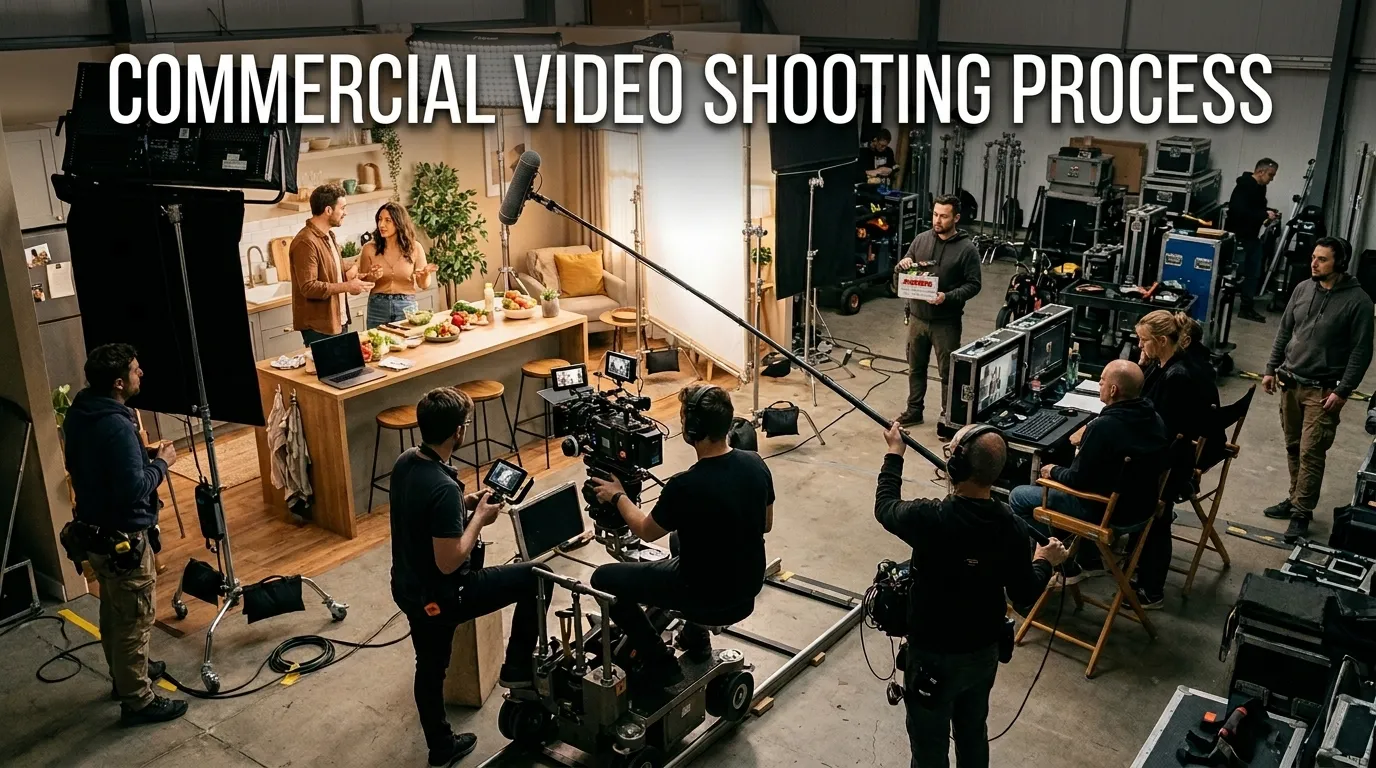 The commercial video shooting process is where the production team captures the footage required for the final advertisement. This stage requires coordination between the director, cinematographer, camera operators, lighting technicians, sound professionals, actors, and production assistants. Before filming begins, the director reviews the storyboard and explains the requirements of each scene. Camera operators position their equipment, lighting technicians adjust the lighting setup, and sound professionals check microphones and recording conditions. Actors and presenters also receive guidance about their dialogue, expressions, and movements.
Professional filming often requires multiple takes to achieve the best possible result. Directors may ask performers to repeat a scene to improve delivery, timing, or emotional expression. Camera teams may also record different angles and additional footage to give editors more creative options during post-production. The TV Commercial Production Process depends heavily on effective communication during filming. Everyone involved should understand the production schedule and creative expectations. Good coordination reduces delays and helps maintain the quality of the recorded material. Modern commercial shoots may also include drones, motion-control cameras, green screens, and specialized lighting equipment. The choice of technology depends on the advertisement’s concept and available budget. However, expensive equipment alone does not guarantee an effective commercial. The most important factors remain creative direction, professional execution, and a clear advertising message.
TV Commercial Post-Production Editing
Post-production is the stage where recorded footage is transformed into a complete television advertisement. It includes video editing, color correction, sound design, music selection, voiceover recording, visual effects, and final quality checks. The editing process begins with reviewing and organizing the recorded footage. Editors select the strongest shots and arrange them according to the approved script and storyboard. They adjust scene timing, remove unnecessary footage, and create smooth transitions between different parts of the commercial. Sound is another important element. Background music can create an emotional atmosphere, while voiceovers help communicate product information and brand messages. Sound effects can also make certain scenes more engaging. Every audio element should be balanced carefully so that dialogue remains clear and understandable.
Color correction and color grading improve the overall visual appearance of the advertisement. These techniques help maintain consistent colors, brightness, and contrast throughout different scenes. Graphics, animations, logos, and text overlays may also be added to highlight important information. A professional TV Commercial Production Process should include several rounds of review before the advertisement is finalized. Clients need an opportunity to check the video and request reasonable adjustments. The production team should also verify the final duration, aspect ratio, resolution, audio levels, and technical specifications required by the intended broadcaster.
Professional TV Advertisement Production
Professional TV advertisement production requires a combination of creative talent, technical knowledge, and marketing experience. Businesses often work with specialized production companies because professional teams can manage the complete process, from concept development to final delivery. An experienced production company understands how to translate business objectives into effective visual communication. It can recommend suitable production styles, develop scripts, arrange casting, organize filming, and complete post-production work according to the client’s requirements. Choosing the right production partner is an important decision. Businesses should evaluate a company’s previous work, creative capabilities, communication process, production experience, and pricing structure. Reviewing a portfolio can help determine whether the company has experience producing advertisements similar to the desired project.
The TV Commercial Production Process should also be aligned with the business’s overall growth strategy. Television advertising can introduce a brand to a broad audience, while digital advertising can help businesses maintain engagement and generate measurable responses. For example, companies selling products online may combine television exposure with Facebook ads for ecommerce to reach potential customers through social platforms and support online sales. Professional production is not only about creating a visually impressive video. It is about developing an advertisement that communicates the right message, represents the brand accurately, and supports measurable business objectives.
TV Commercial Production Techniques
Modern television advertising uses different production techniques to capture attention and communicate messages effectively. The right technique depends on the product, target audience, advertising objective, and creative concept. Storytelling is one of the most effective approaches. Instead of simply describing a product, a commercial can present a relatable situation that demonstrates how the product improves everyday life. Emotional storytelling can help viewers connect with a brand and remember its message.
Product demonstrations are another popular technique. They allow businesses to show how a product works, explain its features, and demonstrate its benefits. This approach is particularly useful for electronics, household products, beauty items, and other products where visual demonstrations can influence purchasing decisions. Animation and motion graphics can also make advertisements more engaging. They are useful for explaining complicated services, presenting statistics, highlighting product features, and creating visual effects that may be difficult to capture through traditional filming.
The TV Commercial Production Process may also use close-up shots, slow motion, cinematic lighting, aerial footage, and creative camera movements. These techniques help establish a distinctive visual identity and make the advertisement more appealing. However, production techniques should always support the message rather than distract from it. Businesses should select techniques that match their brand personality and audience expectations. An effective advertisement communicates its main idea clearly while using visuals and sound to strengthen the overall experience.
TV Ad Production Workflow
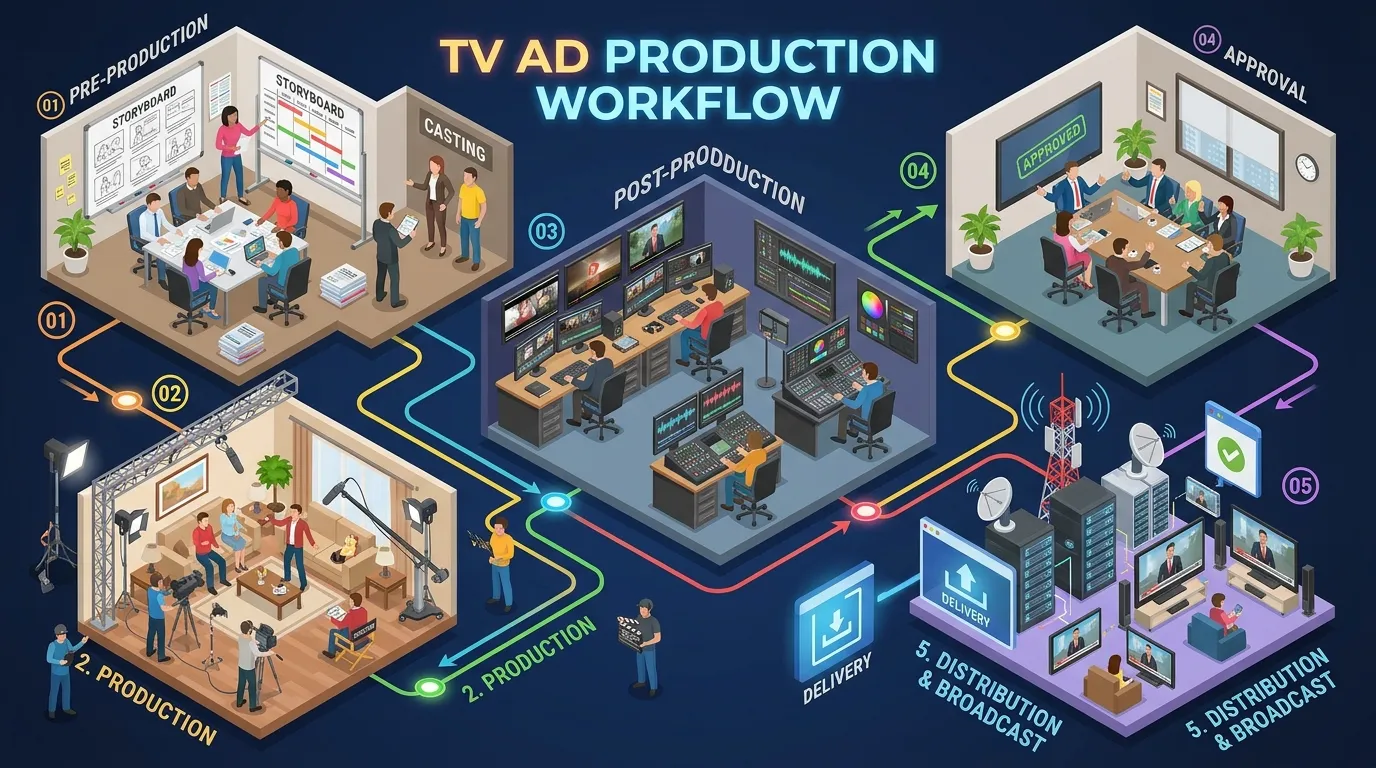 A structured production workflow helps businesses and production companies complete advertisements efficiently. It establishes clear responsibilities, organizes resources, and ensures that each stage is completed before the next one begins. The workflow generally starts with an initial client meeting, where the production team learns about the business, advertising goals, target audience, and budget. After this discussion, the creative team develops the concept and prepares a script for approval.
Once the creative direction is finalized, the production manager coordinates pre-production activities, including casting, location selection, equipment preparation, and scheduling. The filming stage follows, during which the team captures the footage according to the approved production plan. After filming, editors and other post-production professionals assemble the commercial. The client reviews the first version and provides feedback. Necessary changes are completed before the final advertisement is exported in the required broadcast format.
The TV Commercial Production Process does not end when the final video is delivered. Businesses should also consider media placement, broadcasting schedules, audience reach, and campaign performance. Evaluating advertising results helps companies understand whether the commercial is achieving its intended objectives. Television advertising can also support broader business growth when integrated with other promotional activities. Companies interested in improving their overall marketing approach can explore these business growth strategies to understand how different business and marketing activities can work together. Similarly, television advertising can be part of a wider traditional marketing strategy. Businesses can learn more about the benefits of television advertising for businesses when evaluating the role of broadcast media in brand awareness and customer communication. Companies developing educational resources or online offerings may also find useful ideas in this guide to digital products for entrepreneurs. Ultimately, an organized workflow ensures that creative ideas, production resources, and marketing objectives remain connected throughout the project.
Conclusion
Producing an effective television advertisement requires careful planning, creative storytelling, professional filming, and detailed post-production. Every stage contributes to the quality and performance of the final commercial. Businesses that understand the production requirements can make better decisions, manage their budgets, and communicate more effectively with production teams. A successful TV Commercial Production Process begins with a clear advertising objective and continues through concept development, pre-production, shooting, editing, and final distribution. By combining professional expertise with a strong marketing strategy, businesses can create television advertisements that attract attention, strengthen brand recognition, and support long-term growth.
FAQ
1. What is the TV Commercial Production Process?
The TV Commercial Production Process is the complete series of activities involved in creating a television advertisement. It includes research, concept development, scriptwriting, pre-production planning, filming, editing, sound design, and final delivery for broadcasting.
2. How long does it take to produce a TV commercial?
The production timeline depends on the advertisement’s length, complexity, budget, and creative requirements. A simple commercial may take a few weeks, while a more complicated production involving multiple locations, actors, animation, and visual effects may require several weeks or longer.
3. What are the main stages of television commercial production?
The main stages include research and concept development, scriptwriting, pre-production, filming, post-production, quality control, and final delivery. Each stage contributes to creating a professional and effective advertisement.
4. How much does professional TV commercial production cost?
The cost varies depending on the production company’s experience, equipment requirements, location, actors, crew size, filming schedule, and editing complexity. Businesses should establish a realistic budget and request a detailed production estimate before starting the project.
5. Why is pre-production planning important for TV advertisements?
Pre-production planning helps organize the script, budget, locations, actors, equipment, and shooting schedule. It reduces production delays, minimizes unexpected expenses, and ensures that everyone understands the creative direction.
6. What equipment is needed to shoot a television commercial?
Professional television commercials may require cinema cameras, lenses, lighting equipment, microphones, audio recorders, tripods, stabilizers, and monitoring equipment. Additional tools depend on the commercial’s creative requirements.
7. What happens during TV commercial post-production?
Post-production includes reviewing footage, editing scenes, adding music and voiceovers, adjusting colors, creating graphics, incorporating visual effects, and preparing the final video for broadcast. It transforms raw footage into a polished advertisement.
8. How can businesses make their TV commercials more effective?
Businesses can improve advertising effectiveness by understanding their target audience, developing a memorable message, using professional visuals, incorporating engaging storytelling, and including a clear call to action. Consistent branding also helps viewers recognize and remember the business.
9. Can a TV commercial also be used for digital marketing?
Yes. Businesses can adapt television commercials into shorter videos for social media, websites, YouTube, and other digital advertising platforms. However, different platforms may require adjustments to video length, aspect ratio, captions, and messaging.
10. How do I choose the right TV commercial production company?
Businesses should review production portfolios, previous client projects, creative capabilities, technical expertise, communication practices, and pricing. Choosing a company that understands the brand’s objectives and target audience can make the entire production experience more effective.